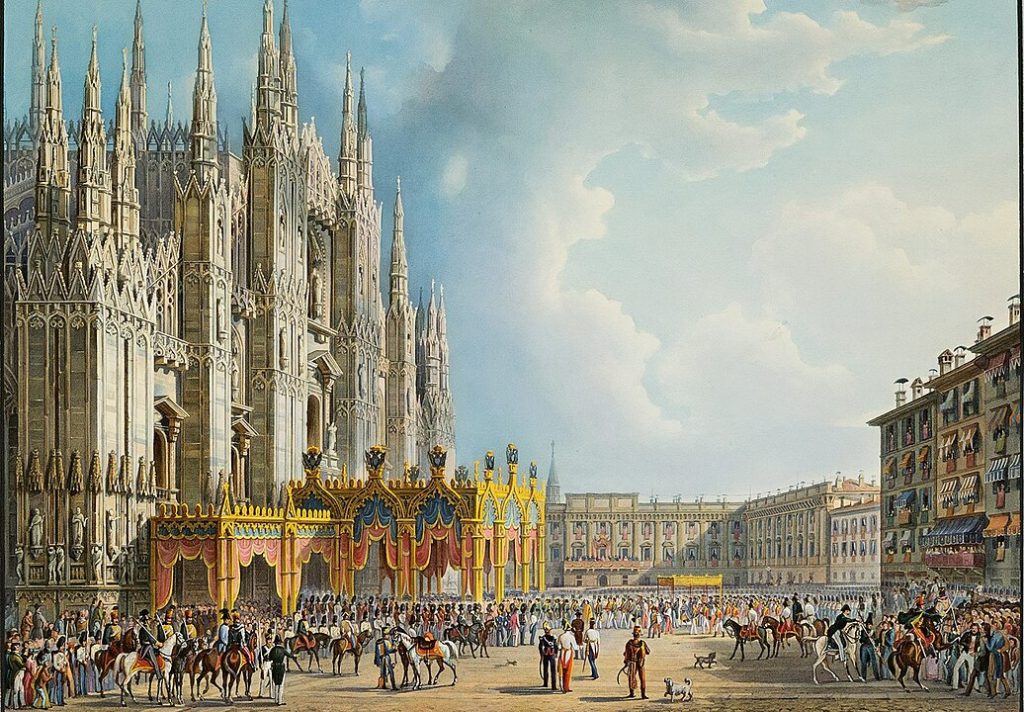
Towering over the Piazza del Duomo in the heart of Milan, the Duomo di Milano is one of the largest and most elaborate cathedrals in the world. With its forest of spires, ornate pinnacles, and thousands of statues, the cathedral is both a work of art and a feat of engineering. Begun in 1386 and not officially completed until the 20th century, the Duomo embodies over 600 years of architectural ambition, reflecting shifting styles, political powers, and religious devotion.
Dedicated to the Nativity of Saint Mary, the Duomo is the seat of the Archbishop of Milan and a spiritual symbol of the city. It’s also a monument to perseverance, having weathered the Black Death, Napoleonic campaigns, world wars, and modernization. The structure represents a complex fusion of Gothic, Renaissance, Baroque, and Neoclassical influences, all united by the consistent use of bright white Candoglia marble.
Few cathedrals in Europe rival the Duomo’s scale. Measuring 157 meters in length and 108 meters at its tallest spire, it is the largest church in Italy (St. Peter’s Basilica is technically in Vatican City) and third-largest in the world by volume. But beyond the stats, what truly distinguishes the Duomo is its architectural detail—a stunning array of statues, flying buttresses, stained glass, and ornate tracery that transforms stone into lace.
Standing before it, or walking on its rooftop among the spires, visitors feel the awe that generations of builders, worshippers, and architects intended. The Duomo is not just Milan’s spiritual heart—it’s one of the world’s greatest architectural achievements, and its story is as complex as its structure.
Beginnings: Vision, Politics, and Foundations
Construction of the Duomo began in 1386, initiated by Gian Galeazzo Visconti, the powerful Duke of Milan. His motivation was both spiritual and political: to glorify God, legitimize his rule, and place Milan at the center of European culture and power. The site chosen was not empty—it previously held the Basilica di Santa Maria Maggiore and the Basilica of Santa Tecla, which were gradually demolished to make way for the new cathedral.
From the start, Visconti wanted the project to be international. He rejected the traditional Italian Romanesque style in favor of the French Gothic, then flourishing north of the Alps. To realize this vision, he imported architects and artisans from France, Germany, and beyond. The first chief engineer, Simone da Orsenigo, was Italian, but he was quickly joined by French master builders, and later German specialists in vaulted ceilings and flying buttresses.
Construction of the foundations and apse began shortly after 1386. Workers used local Candoglia marble, sourced from a quarry donated by Visconti in the Val d’Ossola near Lake Maggiore. He even issued a decree allowing the marble to be transported via canals without tax—an early example of state support for architectural ambition. The choice of marble gave the Duomo its signature pale, almost luminous appearance.
Early work focused on the eastern end of the church, including the choir and transept. The Gothic plan included five naves (a central nave and two side aisles on each side), flying buttresses, and pointed arches—all relatively new to northern Italy. The choir was consecrated in 1418, and construction slowly advanced westward over the following centuries.
Despite a strong initial push, the sheer complexity and cost of the project meant that progress was often slow and uneven. Different architects came and went, each leaving their mark. By the 16th century, only parts of the nave and façade had been completed, and new styles like the Renaissance began to influence additions. The Duomo’s architecture, like Milan itself, was constantly in dialogue with changing times.
Gothic Grandeur: Verticality and Ornamentation
The defining style of the Duomo is Flamboyant Gothic, an offshoot of French High Gothic characterized by elaborate ornamentation, vertical emphasis, and a lace-like quality in stone. While Gothic architecture was not native to Italy, the Duomo demonstrates how the style could be adapted to local tastes and materials. Its execution in marble—rather than French limestone—gave it a more polished and luminous surface, allowing intricate detail to be carved with astonishing precision.
One of the cathedral’s most iconic features is its forest of spires. The Duomo has 135 spires, each one topped with a statue, and each crafted with different decorative elements. These spires are not just symbolic of heaven-reaching faith—they also serve structural purposes, anchoring vertical buttresses that counteract the lateral thrust of the vaulted ceilings.
The facade, although completed in the 19th century, was designed to match the Gothic aesthetic. It features a stunning array of niches, statues, pointed gables, and traceried windows. Five large doorways lead into the cathedral, each with bronze doors richly decorated with biblical scenes and stories from Milanese history.
Flying buttresses—typically an external feature—were adapted to blend with the aesthetic. On the Duomo, they appear more decorative than structural, but they still carry real loads, especially along the apse and choir. Gargoyles and grotesques, both functional as water spouts and symbolic as protectors, line the upper edges of the roof.
Inside, the verticality continues. The central nave rises over 45 meters, supported by massive pillars and a ribbed vaulted ceiling. Light pours in through stained glass windows, some dating back to the 15th century. The effect is one of overwhelming grandeur—stone transformed into a spiritual vessel that lifts the eye and soul upward.
The Roof and Spires: Walking Among the Clouds
One of the most unique features of the Milan Cathedral is that its roof is accessible to the public. Visitors can walk along terraces and among spires, viewing the cathedral from a perspective few other cathedrals offer. This rooftop forest of pinnacles, statues, and marble detail makes the Duomo not just an object to look at, but an architectural landscape to enter.
The rooftop is crowned by the cathedral’s tallest spire—the guglia maggiore, or main spire—which rises 108.5 meters and is topped by the Madonnina, a gilded bronze statue of the Virgin Mary added in 1774. Created by sculptor Giuseppe Perego and built by Francesco Croce, the Madonnina became one of Milan’s most beloved symbols. For years, no building in Milan was allowed to rise higher than her.
The roof structure itself is complex, with sloped marble tiles and hidden drainage systems. The weight of the stone and the weathering from centuries of wind and rain have made maintenance a continuous challenge. Ongoing restoration projects aim to preserve this rooftop forest, which includes over 3,400 statues—more than any other building in the world.
Notable Rooftop Features:
- Madonnina – 4-meter gilded statue of Mary, symbol of Milan.
- Flying buttresses – Blended into spire design, structurally essential.
- Statues of saints, prophets, and angels – Each spire is topped with unique figures.
- Walkable terraces – Offer panoramic views of Milan and the Alps on clear days.
This rooftop is more than a viewing platform—it’s an integral part of the architectural experience. It showcases the Duomo’s ambition not just in size, but in height, craftsmanship, and accessibility. From above, the cathedral becomes a literal and symbolic ascent toward the divine.
Interior Majesty: Light, Scale, and Symbolism
Stepping inside the Duomo, visitors are enveloped by a vast, soaring space filled with columns, color-filtered light, and monumental art. The cathedral has five naves, with the central nave flanked by two side aisles on either side, making the interior among the widest and tallest of any Gothic cathedral in Europe. The sheer scale is intended to evoke awe, with the main vaults rising over 45 meters—comparable to Notre-Dame in Paris or Cologne Cathedral.
The interior is defined by 52 massive pillars, one for each week of the year, carved from solid marble and adorned with capitals featuring floral and religious motifs. These support a system of ribbed vaults, one of the Gothic style’s signature innovations. The ribs not only distribute weight but also create a visual pathway upward, leading the eye toward heaven.
Light enters the cathedral through more than 50 stained glass windows, some reaching 20 meters high. These windows are among the most intricate in Europe, featuring scenes from the Old and New Testaments, lives of saints, and even apocalyptic visions. Though some date back to the 15th century, others were added in the 19th and 20th centuries, continuing the narrative art tradition in glass.
At the front of the cathedral sits the high altar, surrounded by a richly carved marble choir screen and massive candlesticks. Nearby is the presbytery, featuring bronze reliefs and marble sculptures by Renaissance and Baroque artists. To the left of the altar is a crypt where Carlo Borromeo, the beloved 16th-century Archbishop of Milan and Counter-Reformation figure, is entombed in a crystal coffin.
A notable feature is the Sundial Line, installed in the 18th century by astronomers of the Accademia di Brera. A small hole in the wall allows a ray of sunlight to mark the solar noon, aligning with a line in the floor decorated with zodiac symbols. This blend of science and sacred architecture speaks to the cathedral’s role as both a religious and civic center.
The Duomo’s Long Road to Completion
The Duomo’s construction stretched over six centuries, with major phases taking place in the 14th–16th centuries, another surge during the 17th–18th centuries, and final touches added in the 19th and 20th. Each phase brought new artistic trends and political influences. What began as a French Gothic project evolved into a hybrid that incorporates Renaissance detail, Baroque sculpture, and Neoclassical additions.
By the 16th century, construction had stalled. The nave was incomplete, and disagreements over style slowed progress. Leonardo da Vinci, who worked in Milan during the late 1400s, was asked to consult on structural issues but left no lasting contributions. Carlo Borromeo, a major ecclesiastical reformer, pushed to resume building, especially the façade, which had remained incomplete for over a century.
In the Napoleonic era, construction received new momentum. When Napoleon Bonaparte declared himself King of Italy, he demanded the façade be finished before his coronation in Milan in 1805. He ordered state funds to be directed to the project and even said, “The façade will be completed—and I will pay for it myself if necessary.” Though his exact funding is debated, the façade was largely finished in time for his coronation.
The final spire was placed in 1965, officially marking the end of structural work. However, restoration is constant. The Veneranda Fabbrica del Duomo, the institution established in 1387 to manage the construction and maintenance, still operates today, overseeing conservation and repair of the marble, spires, stained glass, and statuary.
This drawn-out construction history means that the Duomo does not represent a “pure” architectural style—but that’s exactly what makes it exceptional. It is a palimpsest of six centuries of artistic vision, cultural change, and technical innovation, layered into one monumental structure.
Preservation, Restoration, and Cultural Role
Maintaining a structure as vast and intricate as the Duomo is a never-ending task. Candoglia marble, while luminous and beautiful, is also porous and prone to weathering, especially in modern urban environments. Acid rain, pollution, and seismic activity have all contributed to erosion of the façade and spires, necessitating continuous conservation work.
The Veneranda Fabbrica del Duomo employs specialized stonemasons and artisans who work year-round to clean, repair, and replace damaged elements. When restoration is required, new marble is sourced from the same quarry used in the 14th century. Laser cleaning techniques, structural analysis, and digital modeling are used alongside traditional tools like chisels and scaffolding.
Preservation isn’t limited to the structure. The cathedral’s art, stained glass, and liturgical items are curated in the Duomo Museum, located next to the church. The museum houses original statues, architectural models, tapestries, and liturgical objects that span centuries of Milanese religious life.
In modern Italy, the Duomo remains not only a religious symbol but also a cultural icon. It hosts major religious events, concerts, and public gatherings. Even secular visitors often light a candle or pause in silence beneath the soaring vaults. The Duomo’s rooftop is one of the most visited attractions in Milan, and its silhouette dominates city souvenirs, posters, and emblems.
A massive restoration campaign began in the 2000s and continues today, funded in part by public donations, corporate sponsorships, and ticket revenue. Special initiatives, like “Adopt a Spire,” allow individuals to sponsor specific parts of the cathedral—fitting for a building that was, from the beginning, a communal act of devotion and pride.
Conclusion: The Eternal Cathedral of Milan
The Duomo di Milano is not merely a cathedral—it’s a chronicle carved in stone, a testament to Milan’s faith, resilience, and artistic ambition. Every inch of its towering façade, its forest of spires, and its glowing stained glass tells a story that spans more than six centuries. It is both a relic of medieval piety and a living monument to civic unity and identity.
Its architectural uniqueness lies not in stylistic purity, but in its harmonious complexity. Gothic roots entwine with Renaissance detail, Baroque energy, and Neoclassical grandeur. Built over centuries, it somehow avoids feeling disjointed. Instead, it becomes a physical representation of time itself—a building in conversation with its past, adapting to the present, and open to the future.
What makes the Duomo so compelling is its human scale in superhuman form. It was created not by a single genius but by generations of masons, sculptors, architects, and believers. Its stones bear the fingerprints of history—French engineers, Italian visionaries, Napoleon’s ambition, and countless unnamed workers who lifted each block into place.
Today, as visitors ascend its terraces or kneel in silent prayer, the Duomo continues to fulfill its purpose—not only as a house of worship, but as an enduring expression of the human spirit’s reach toward the divine. Milan may have changed around it, but the cathedral remains the city’s sacred heart and crown.
Key Takeaways
- The Duomo di Milano began construction in 1386 and was officially completed in the 20th century.
- It combines Gothic, Renaissance, Baroque, and Neoclassical styles using Candoglia marble.
- With 135 spires and over 3,400 statues, it is the most ornate Gothic cathedral in the world.
- The roof is accessible, offering views of Milan and close-up detail of its sculptural work.
- Ongoing restoration ensures its survival as a living symbol of Milanese faith and identity.
FAQs
- How long did it take to build the Duomo di Milano?
Construction began in 1386 and officially concluded in 1965, spanning nearly 600 years. - What style of architecture is the Duomo?
It is primarily Gothic, with strong elements of Renaissance, Baroque, and Neoclassical design. - Can you walk on the Duomo’s roof?
Yes, visitors can access the rooftop terraces and walk among the spires and sculptures. - Why does the Duomo use Candoglia marble?
The marble was donated by Duke Visconti and gives the cathedral its luminous, pale appearance. - Who manages the Duomo’s restoration today?
The Veneranda Fabbrica del Duomo, founded in 1387, still oversees all conservation work.